

Mark Van Loosdrecht was born in July 1959 in the Netherlands. He received his PhD degree from Wageningen University in 1988 and taught at Delft University of Technology in the same year. He has been the head of the Department of Environmental Biotechnology at DUT since 2003.He was elected as a member of the Netherlands Academy of Engineering in 2007 and as a foreigner member of the Chinese Academy of Engineering in 2019. He received the Great Wall Friendship Award of Beijing in 2024.

On September 23, 2024, Loosdrecht was interviewed by the Global People Magazine reporter at Beijing University of Civil Engineering and Architecture. (Photographer: Hou Xinying)
“Is there some ‘special smell’ in our lab? Don’t worry, as long as you stay here long enough, you can’t smell that.”Mark van Loosdrecht, a foreign member of the Chinese Academy of Engineering, said humorously when the journalist of Global People visited the wastewater treatment laboratory.
During the hours with Loosdrecht, the journalist of Global People found that he always has the “enthusiasm” exclusive to freshmen when he works at Beijing University of Civil Engineering and Architecture (BUCEA), although he is in his sixties, as well as a top scholar with a high reputation in the international academic circles. Whether answering questions for doctoral students or checking experimental equipment, Loosdrecht always inadvertently shows a satisfied smile.
“I enjoy life at the university because I can follow my heart to research. For me, the beginning of scientific research should be curiosity and the final goal should be to let people live a better life. Our work here is up to these two standards,” Loosdrecht said.
In 2000, Loosdrecht came to China for the first time. Before that, he had already worked with wastewater treatment for a long time and gained two international awards: the Stockholm Water Prize and the Lee Kuan Yew Water Prize in Singapore. During many years of teaching at Delft University of Technology (TU Delft), he not only cultivated many leading talents in the water resources in China but also explored a new pathway with Chinese scholars for China’s water purification industry.
In China, we can do more.
The “Sino-Dutch R&D Center for Future Wastewater Treatment Technologies” laboratory instructed by Loosdrecht located in the basement of a teaching building at the Daxing campus of BUCEA. In many people’s minds, the laboratory must be full of precision instruments and many scientists in white lab coats doing research. But Loosdrecht’s laboratory is filled with “the scent of the earth”, and it sounds like a 24-hour continuous working small factory, mixing with all kinds of sewage treatment machines’ sound of roar and water flow.

Loosdrecht interacted with Chinese students and faculty at a presentation in Beijing in 2019.
Loosdrecht introduced, “Our laboratory is equivalent to a miniature sewage treatment plant. Some of the sewage here is collected from the surrounding areas, some are made by ourselves. The purpose is to test the effect of new sewage treatment solutions on different types of sewage. Our main study is how to extract and reuse the elements in sewage such as phosphorus, nitrogen, and carbon. The experimental achievements obtained in the small laboratory can help us establish a real high-tech wastewater treatment center.”
Loosdrecht emphasized that not all used water is wastewater. “‘Waste’ means that this water has no value in use. But in fact, there are still many undeveloped ‘treasures’ in the industrial and agricultural sewage. For example, phosphorus in agricultural sewage can be re-extracted and used as fertilizer. Many organic matters in sewage can not only be used as bioenergy, but also as building materials after treatment.”
As a visionary expert in water resources, Loosdrecht put forward the new concept of sustainable wastewater treatment 30 years ago and achieved the recovery of high-value-added products like bioplastics, alginate, and blue iron ore from wastewater. When he first came to China, he and his former student Hao Xiaodi, also a professor of BUCEA, jointly proposed that China’s wastewater treatment technology should take a sustainable path and pay attention to the recovery of resources and energy in wastewater as the key to technology development. In the following 20 years, he has been making efforts to achieve sustainable development in China’s wastewater treatment.
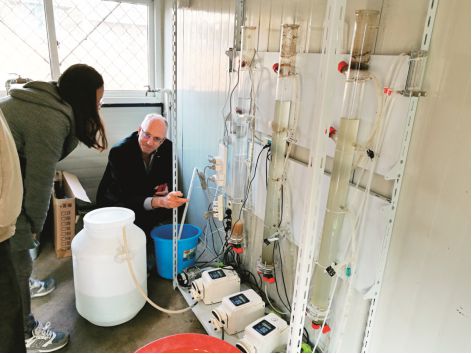
In 2017, Loosdrecht guided experiments at the pilot site in Dongba, Beijing
Internationally, Loosdrecht is well-known for leading the study of aerobic granular sludge technology. This technology lets micro precipitate into “organ sludge” after absorbing organic and inorganic substances in sewage, using the biological aggregation phenomenon. Compared with traditional chemical and physical sewage treatment measures, the aerobic granular sludge technology has higher purification efficiency, less energy consumption, and is beneficial to recycle resources in sewage. Under his instruction, the Chinese technological research team successfully let aerobic granular sludge technology CREATE achieve industrialized, laying the foundation for the leapfrog development of China’s wastewater treatment technology.
Loosdrecht believes that aerobic granular sludge technology accords with the Chinese “ecological civilization” concept: “Circular economy is an important part of ‘ecological civilization’ concept. Our goal is to make human civilization, like nature, form a ‘closed loop’ of resource recycling and utilization. Aerobic granular sludge technology exactly introduces a natural recycling pattern into human society to achieve reuse of resources. That truly makes our city become an ecosystem with self-metabolism.”
Loosdrecht very enjoys the works in China, “Compared with the Netherlands, China is a big country with a population of 1.4 billion, so the situation of sewage treatment is more complex and diverse. In China, we can learn more knowledge and contribute more to society. This is also the main reason why I and some Dutch water resources experts chose to work in China.”
However, the fate between Loosdrecht and China has not stopped. A few hundred years ago, his alma mater was left with a touch of “Chinese blue”.
The “Chinese blue” in a renowned Dutch university
Outside the office of the “Sino-Dutch R&D Center for Future Wastewater Treatment Technologies”, the journalist of Global People noticed that, the “U” representing “university” in the abbreviation of the name of Delft University of Technology in the Netherlands have a unique blue color, which is very similar to the color matching on Chinese blue-and-white porcelain.

The Logo of Delft University of Technology.
“In the Netherlands, people always name this color as ‘Delft blue’. This blue has a deep connection with China,” Loosdrecht explained with a smile. As Loosdrecht’s alma mater, TU Delft is one of the best Europe’s leading engineering institutions. But before its establishment, Delft City was renowned for Chinese porcelain in Europe.
In the 17th century, Dutch merchants brought vast quantities of Chinese blue-and-white porcelain back to Europe. These exquisitely crafted and beautifully designed artworks sparked a “Chinoiserie” across Europe, quickly becoming one of the most popular imported goods. However, as the Ming dynasty faced increasing turmoil, the quantity of porcelain exported to Europe dramatically decreased. To fill this market gap, Dutch potters in Delft began studying Chinese porcelain techniques, eventually creating their own “blue-and-white porcelain of Dutch version”: Delftware. Consequently, Delft University of Technology incorporated “Delft Blue” into its emblem.
“Centuries ago, Chinese craftsmen brought porcelain-making techniques to Delft. Today, TU Delft collaborates with Chinese institutions to build the ‘Blue Water Factories.’ This is also a historical fate,” Loosdrecht remarked.
In 1988, Loosdrecht came to TU Delft to serve as an assistant professor. He told the journalist smilingly that he had some resistance to teaching at university at the beginning. “I am delighted to solve problems in practice so I aspire to work in the industrial field after PhD, but finally my teacher recommended a teaching career for me. Who would have thought that decades later, I would love university life so much?”
Loosdrecht described his entry into the wastewater treatment field as a natural “coincidence”: "I have loved nature since childhood, and hiking is my lifelong hobby, which makes me focus on environmental protection. Today, I still keep the tradition of hiking in the Netherlands with my students every year. At the same time, I am also interested in biology and chemistry, and sewage treatment combines them well.”
He believes that if we want to conduct effective wastewater treatment research, firstly we need to clarify the relationship between theoretical research and engineering practice: “Wastewater treatment research not only requires vast scientific theoretical foundations as support, but also emphasizes the feasibility of engineering practice and industrialization. This requests we work on both sides between university and enterprise. In my view, the emphasis of scientific research and industrial practice is different and should not be mixed, but collaboration between research institutions and the industrial sector is the premise for transforming research outcomes into societal value.”
In this context, Loosdrecht has become not only an outstanding researcher but also a master at converting scientific results into productivity. Under his leadership, Delft TU's research team was the first in the world to achieve large-scale engineering applications of aerobic granular sludge technology in wastewater treatment, successfully promoting it in 13 countries worldwide.
As Loosdrecht's academic reputation soared, in 1999, he met his first Chinese doctoral student, Hao Xiaodi. At that time, he could not have imagined that over the next two decades, China would become a significant part of his life.
Chinese people boast a drive for progress.
“I first met Professor Loosdrecht in 1992. At that time, all the Dutch people I met said that his brain reacted faster than a computer. After communicating with him, I made up my mind to go to his workplace to pursue a PhD." said Hao Xiaodi, who is now a professor at Beijing Architecture University, to reporters from Global People. Although Hao Xiaodi is Loosdrecht's student, they're only one year apart in age. Soon, Loosdrecht became both Hao's teacher and friend.

The photo of professor Loosdrecht(right) and professor Hao Xiaodi.
Hao Xiaodi invited Loosdrecht to China for the first time in 2000. "At that time, Beijing was still plagued by air pollution, and China’s rules and regulations for sewage treatment were not well-developed, but I saw that the Chinese people then were striving to change the status quo. Look at the sky in Beijing today, how blue it is!" said Loosdrecht.
After arriving in China, Loosdrecht found that the municipal sewage treatment technology in China is still mainly based on traditional processes, and the research and development level is limited. In order to help China change this situation, he has held over 60 academic lectures in China, teaching advanced municipal sewage treatment technologies from abroad.
Over the past two decades, Loosdrecht has visited China countless times, yet he has some small regrets. “Every time I come to China, most of my time has been spent in the lab or at academic events, leaving little time to go out. As a hiking fan, I have only climbed Huashan Mountain of ‘China’s Five Great Mountains’. The cliffs and mysterious clouds and mists of Mount Hua have left me with unforgettable memories for a lifetime.”
Loosdrecht expressed admiration for the passion and ambition demonstrated by his Chinese colleagues. “In Chinese scholars and engineers, you can feel a drive for progress. They see developing China's infrastructure as their professional mission and are also very bold in technological innovation. When I first came to China, my main job was to impart knowledge. But today, I am able to exchange ideas with Chinese scholars. A series of new concepts proposed by China, such as the ‘sponge city’ concept in urban stormwater management, have also gained worldwide recognition.”

In 2016, Loosdrecht (third from right) inaugurated the Sino-Dutch R&D Center for Future Wastewater Treatment Technologies and Pilot Base.
“I believe that China's academic openness holds significant importance for the world. For scholars, stepping out of their comfort zones is crucial. My experiences in China have provided me with many new insights and perspectives. I hope more international scholars will come to China for exchanges and encourage Chinese scholars will go out to explore more.”
In 2015, China implemented the "Action Plan for Prevention and Control of Water Pollution". A year later, Loosdrecht, representing TU Delft, co-founded the Sino-Dutch R&D Center for Future Wastewater Treatment Technologies with BUCEA and Beijing Capital Eco-Pro Group (BCEPG), aiming to promote the application and transformation of research achievements.
Loosdrecht suggested that over the years, China has made many significant progresses in water resource protection and utilization, leading to remarkable improvements in urban water quality and wastewater treatment capabilities. He believes that there are two important reasons for this. On the one hand, China has made noticeable advancements in its water resource protection supervision policies, often exceeding the rigor of some developed countries. On the other hand, China is willing to adopt new technologies and ideas. Technologies that might take years to deploy in Europe can often be piloted in China within just months.
Loosdrecht acknowledged that China is still facing some challenges in the transformation of research results into practical applications, and many research institutions still experience a “distance” from industry and investment sectors. “As a scientist, we need to focus more on how our research results can benefit humanity. This means we must not only showcase the scientific potential of our findings but also demonstrate the economic and social value they can create for society. Only then can we bring research outcomes out of the laboratory and into people’s lives.”
 Editor:Zheng Aotian

